
Welcome to another Foundations entry in our Eschatology series. The feedback we have been getting on this series has been great, and we pray that God continues to fill us with knowledge and revelation so we can write more!
If you have not checked out the previous entries (e.g., Revelation Starter Pack, 7 Things Needed Before Tribulation, etc.), no worries! These are not written in order, so feel free to check out the others after this one. This entry forms part of our foundational teachings. Similar to what we have done in our Old vs New Covenant series, it is important to establish first principles, and then we can start to unpack more in-depth revelations. These deeper revelations will be in the Eschatology Advanced series and will be a members-only exclusive. Sign up for free here.
Many people believe Revelation is written chronologically, in the order that John saw events unfold. However, this is not strictly true. Let's dive into the book and examine the literary structure behind it. Doing this will help bring clarity to a book that many people have long struggled to understand.
What Literary Structure Does Revelation Use?
The book is written in a Chiastic Structure. This means that the themes of texts are presented in a symmetrical pattern, all centered around a main theme or highlight. For example, let's say you have 5 chapters in a book. If you wanted to write it in a chiastic structure, your 5 chapter themes would be in order: A-B-X-B-A. The last chapter will mirror the first chapter's theme (A). Whereas the 2nd last chapter would mirror the 2nd chapter's theme (B).
Below is a visual example.
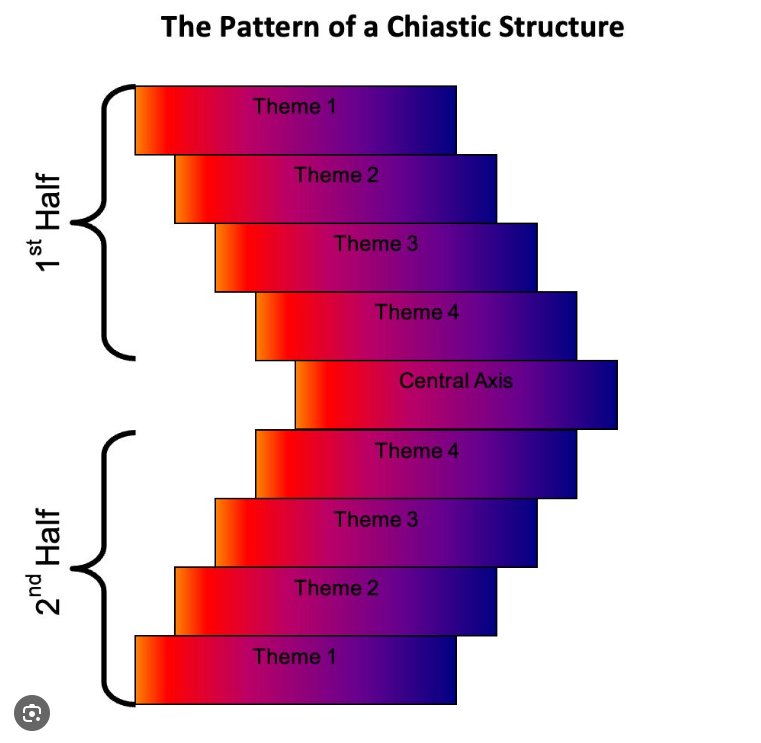
Revelation follows this same structure.
Examples in Revelation
It is actually incredible when you look at these examples:
A. Christ’s Return
Revelation 1:1–20 ↔ Revelation 22:6–21
| Opening Section (Rev 1) | Closing Section (Rev 22) | Theme |
|---|---|---|
| Rev 1:1 – God sends His angel to show His servants what must shortly come to pass | Rev 22:6 – God sends His angel to show His servants what must shortly be done | Divine revelation through angels |
| Rev 1:3 – Blessing on those who read, hear, and keep the prophecy | Rev 22:18–19 – Warning not to add or take away from the prophecy | Faithful handling of prophecy |
| Rev 1:7–8 – Christ coming with clouds; Alpha and Omega | Rev 22:12–13 – Christ coming quickly; Alpha and Omega | The returning, eternal Christ |
B. The Bride of Christ
Revelation 2:1–3:22 ↔ Revelation 21:1–22:5
| Letters to the Churches | New Jerusalem | Theme |
| Rev 2:7 – Promise of the tree of life to overcomers | Rev 22:2 – The tree of life in the New Jerusalem | Restoration of Eden |
| Rev 3:5 – Names not blotted from the book of life | Rev 21:27 – Only those written in the Lamb’s book of life enter | Citizenship in God’s city |
| Rev 3:12 – God’s name and the name of the New Jerusalem written on believers | Rev 22:4 – God’s name on their foreheads | Ownership and identity |
C. Justice
Revelation 4:1–6:17 ↔ Revelation 17:1–20:15
| Early Visions | Final Judgments | Theme |
| Rev 4 – God, His throne, and holiness | Rev 17 – The harlot, the beast, and abominations | True worship vs. false worship |
| Rev 5:1–9 – Crying in heaven turns to joy | Rev 18 – Babylon’s joy turns to mourning | Reversal of joy and sorrow |
| Rev 5:10–14 – God reigns with His people | Rev 19:1–10 – Marriage of the Lamb | God reigning with His redeemed |
| Rev 6:1–8 – White horse and early judgments | Rev 19:11–21 – White horse and final judgment | Christ as righteous judge |
| Rev 6:9–17 – Saints cry for justice | Rev 20:11–15 – Final judgment and reward | Justice completed |
D. Reward of the Righteous & Judgment of the Unrighteous
Revelation 7:1–10:11 ↔ Revelation 14:1–16:21
| Trumpet Section | Bowl Section | Theme |
| Rev 7 – 144,000 sealed and multitude protected | Rev 14 – 144,000 with the Lamb; Babylon judged | Preservation vs. destruction |
| Rev 8:1–6 – Preparation for trumpets | Rev 15 – Preparation for bowls | Heaven prepares for judgment |
| Rev 8:7–9:21 – First six trumpets | Rev 16:1–16 – First six bowls | Parallel judgments |
| Rev 10 – Seven thunders and little book | Rev 16:17–21 – Seventh bowl and thunders | Completion of wrath |
E. Servants of Righteousness & Servants of Unrighteousness
Revelation 11:1–19 ↔ Revelation 13:1–18
| God’s Witnesses | Satan’s Beasts | Theme |
| Rev 11:3 – Two witnesses prophesy | Rev 13:1,11 – Two beasts rise | True vs. false testimony |
| Rev 11:5 – Fire from witnesses destroys enemies | Rev 13:13 – False fire deceives the nations | True power vs. counterfeit signs |
| Rev 11:11 – Witnesses resurrected | Rev 13:3,14 – Beast’s mortal wound healed | Resurrection power vs. imitation |
| Rev 11:15 – Kingdoms become Christ’s | Rev 13:7 – Beast rules over nations | Christ’s reign vs. Satan’s dominion |
| Rev 11:16 – Elders worship God | Rev 13:12 – World worships the beast | True worship vs. false worship |
F. The Seed of the Woman & The Seed of the Serpent
Revelation 12:1–6 ↔ Revelation 12:10b–17
| First Half | Second Half | Theme |
| Rev 12:1–3 – Woman and dragon appear | Rev 12:17 – Dragon wars against her seed | Enmity between the seeds |
| Rev 12:4–5 – Dragon seeks to devour the child | Rev 12:15–16 – Dragon floods after the woman | Satan’s attempt to destroy God’s purpose |
| Rev 12:6 – Woman flees to the wilderness | Rev 12:14 – Woman protected in the wilderness | Divine protection |
| Rev 12:7–9 – War in heaven; Satan cast down | Rev 12:10b–13 – Victory through the Lamb; Satan persecutes |
All this should help us better understand Revelation, as if you struggle to understand a certain theme or verse, you can simply let scripture interpret scripture, and find the parallel verse in the chiasm. This is exactly what we did in our teaching on Cults from Revelation, where the Jehovah's Witnesses' founder (Charles Taze Russel) misinterpreted the verse on the 144,000 (Rev 7:4). If he had done the cross-reference to this verse's parallel in Rev 14, he could have seen the requirements for the 144,000 even more clearly!
The Central Theme
In a Chiastic structure, there is always a central axis where the story pivots. This part in Revelation is the struggle between the Seed of the Woman and the Seed of the Serpent.
Rev 12:10 Then I heard a loud voice in heaven say: “Now have come the salvation and the power and the kingdom of our God, and the authority of his Messiah. For the accuser of our brothers and sisters, who accuses them before our God day and night, has been hurled down.
The enmity here between the woman and the serpent traces back to Genesis 3:
Gen 3:15 And I will put enmity between you and the woman, and between your offspring and hers; he will crush your head, and you will strike his heel.”
God links the entire Bible together here. Pointing backwards to the beginning of it all with Adam and Eve, and also the other famous stories of a divide between God's chosen and Satan:
- Cain & Abel
- Ishmael & Isaac
- Jacob & Esau
- Pharaoh & Moses
- Mordecai & Haman
- Israel vs enemy countries
- And finally, Jesus and His Church vs Satan and his followers.
- Mat 13:38,39 The field is the world; the good seed are the children of the kingdom; but the tares are the children of the wicked one; The enemy that sowed them is the devil; the harvest is the end of the world; and the reapers are the angels.
This struggle will continue until Jesus second coming.
Conclusion
Revelation can be a confusing book for Christians. In this teaching, we showed that one of the reasons for this confusion is the literary structure it is written in - A Chiasm. A literary style where you parallel themes in a story according to an A-B-X-B-A style.
At the very center of this structure, God does not place beasts, judgments, or timelines — but salvation, the kingdom of God, and the authority of Christ:
“Now is come salvation, and strength, and the kingdom of our God, and the power of his Christ…” (Revelation 12:10)
This is the heart of Revelation. It reminds us that Christ is already victorious & Satan is already defeated.
From Genesis to Revelation, the Bible tells one unified story: the ancient enmity between the Seed of the Woman and the Seed of the Serpent. What began in Eden in Genesis 3:15 unfolds through every generation of Scripture, through Israel’s history, through the life and victory of Christ, and continues in the persecution of His Church — until the final triumph when Satan is cast down forever and the kingdom of God is fully established.
Understanding this structure should change how we read Revelation. We now have a tool to help understand Revelation. If you do not understand a verse, you can always find it's parallel theme in the chiastic structure. This most likely would have helped Charles Taze Russel (Founder of the Jehovah's Witnesses) more clearly see that he misinterpreted Revelation 7.
I leave you with this small verse in Revelation 11:
“The kingdoms of this world have become the kingdoms of our Lord, and of his Christ; and he shall reign for ever and ever.” (Revelation 11:15)
Be Blessed!


